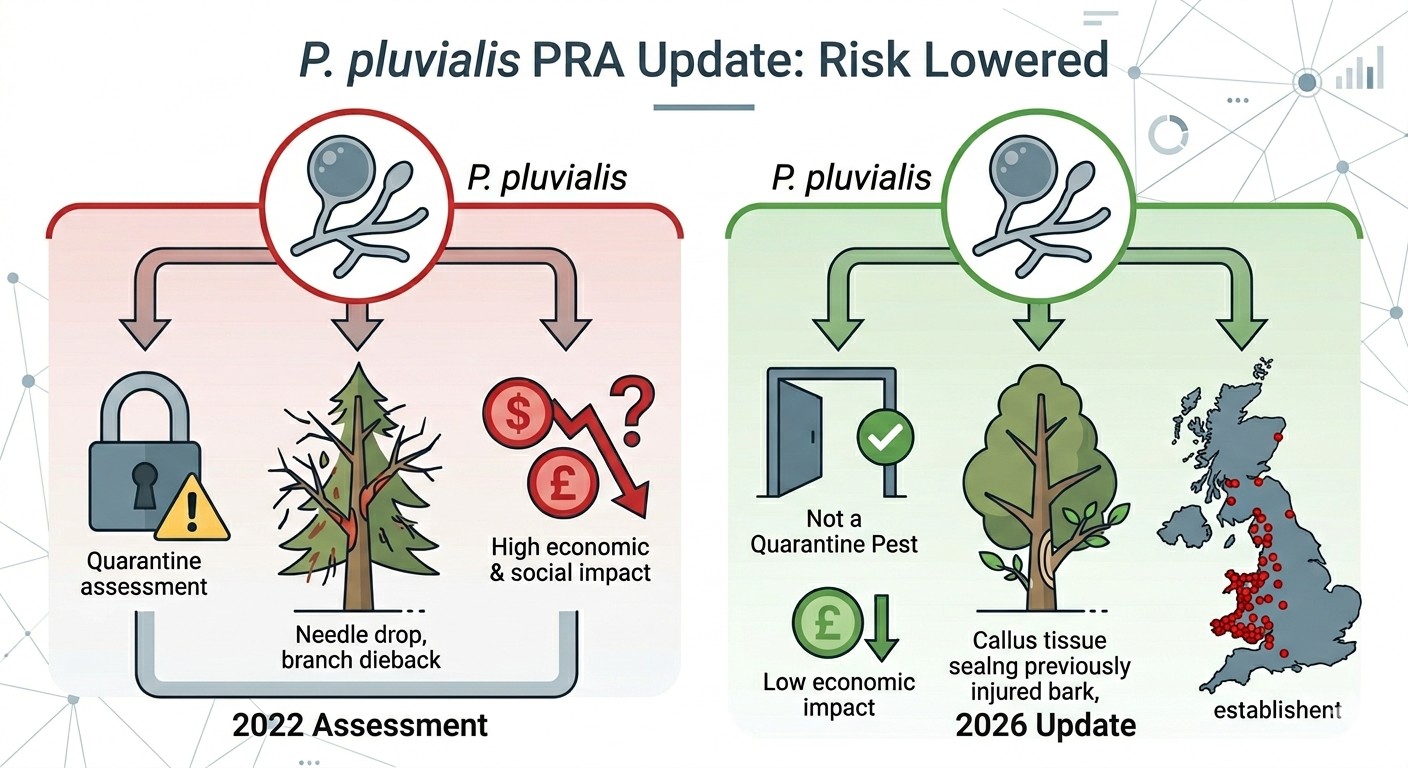

New information supplementary to the 2022 Rapid Pest Risk Analysis (PRA) for Phytophthora pluvialis
March 2026
Background
The rapid PRA for Phytophthora pluvialis was undertaken in 2022, following the first finding of this pathogen in the UK in 2021. The PRA highlighted a lot of uncertainties, and although the pathogen had already established outdoors in some areas of England, Scotland and Wales no final judgement was made as to whether it met the criteria for a Quarantine organism. Management options were put in place, but also a number of research projects were initiated to try and answer the key areas of uncertainty. This document provides updated information on this pathogen in relation to whether it meets the criteria for a Quarantine Pest for Great Britain (GB).
This is not a stand alone document and should be read in conjunction with the 2021 PRA. This PRA can be found via a link on the pest page in the UK plant health risk register1, or one of the choices via the EPPO PRA platform2.
1 https://planthealthportal.defra.gov.uk/pests-and-diseases/uk-plant-health-risk register/viewPestRisks.cfm?cslref=27281
2 https://pra.eppo.int/organism/PHYTUV
Assessment of quarantine plant pest status for Great Britain
Within the meaning of: Article 3 of Assimilated regulation 2016/2031 of the European Parliament of the Council of 26 October 2016 on protective measures against pests of plants (the Plant Health Regulation)
Identity of pest
Pest name: Phytophthora pluvialis
This pest is a defined taxonomic entity. Kingdom – Chromista: Phyllum – Oomycota; Order – Peronosporales; Family – Peronosporacae; Genus – Phytophthora.
Presence of the pest in Great Britain – is pest absent (or has limited distribution)?
No, the pest is present in GB and is not limited in its distribution. While most findings have been on the western side of the UK, this has been determined to be the area of GB most suitable for establishment (PRA, October 2022). There is a wide distribution across this side of the country encompassing England, Wales and Scotland, and therefore in the parts of GB with the most suitable conditions the pest is widespread.
The first detection was in 2021 from a suspect P. ramorum infected western hemlock sample collected from south-west England but later confirmed to be positive for P. pluvialis. Between then and December 2025, there have been a total of 52 findings of P. pluvialis across GB (England: 22 positive forest blocks; Scotland: 9 positive forest blocks; and Wales: 21 positive forest blocks). More recently, there have also been some detections in water courses associated with apparently symptom-free hosts at three sites in Scotland (in Stirling, Argyll & Bute and Highland) and one in England.
Moreover, stored samples of larch and western hemlock bark material collected from Wales during P. ramorum surveillance activities in 2018 and 2019 were retested with a multiplex PCR assay in 2025 and several samples of both tree species were positive for P. pluvialis (Forest Research, unpublished data). This combined evidence indicates P. pluvialis has a sporadic but wide geographical presence across western GB and was already present for some years before visible symptoms on hemlock and Douglas fir caused by the pathogen were first observed.
Distribution in other parts of Europe
Belgium update
Source: NPPO of Belgium (2025-09).
Phytophthora pluvialis was first detected in Belgium in 2023 in the southern part of the country in watercourses and in samples from two Douglas fir tree (Pseudotsuga menziesii) stands. The NPPO of Belgium conducted an official survey throughout Belgium in spring and autumn 2024 in watercourses and in samples of P. menziesii, Tsuga heterophylla and Larix sp. trees from nurseries and (semi-)natural environments in forests. During this survey, P. pluvialis was detected in 4 additional watercourses crossing P. menziesii stands and in P. menziesii plants in a forest nursery that did not show any signs of damage. The watercourses were located in the provinces of Luxembourg, Liege and Namur (Wallonia, southern Belgium). The presence of the pathogen was confirmed by real-time PCR. Phytophthora pluvialis was not detected in Flanders Region, northern Belgium.
The NPPO of Belgium considers that P. pluvialis is established in forest areas in southern Belgium and cannot be eradicated or contained. As there are no symptoms on host plants, the NPPO considers that P. pluvialis does not qualify to be an EU quarantine pest or regulated non-quarantine pest so the status is officially declared as: Present, only in some parts of Wallonia.
Probability of establishment of the pest in Great Britain territory, or the specific part(s) of Great Britain
Yes – Pest has already established outdoors in some areas in GB.
The PRA (October 2022) concludes that environmental conditions throughout at least western GB are predicted to be favourable to P. pluvialis so establishment is very likely and indeed has already occurred at some locations. Risk modelling in Scotland suggests P. pluvialis could establish quite widely throughout West and central Scotland, and parts of Eastern Scotland with lower risk only in the North (Barwell et al., 2025).
Probability of spread of the pest in Great Britain territory, or the specific part(s) of Great Britain
Natural spread
In the 2022 PRA, spread was considered likely to occur at a moderate pace, but that this would be influenced by climate, the range and spatial distribution of host species, and possibly the influence of water courses around disease foci. Due to the lack of
information on aerial dispersal distances and water course dispersal, confidence in this rating was placed at medium.
Since the PRA, established metabarcoding and baiting methodology was applied to soil, stream water and rainwater samples collected from 17 sites across Britain, most of which were confirmed P. pluvialis outbreak sites (MacLaren et al., 2025). Findings suggest that the pathogen may arrive at a site via aerial dissemination or vector mediated transfer in soil, with subsequent local spread along water courses and possibly pathways/roads. This may largely explain the predominant pattern of infections of understorey western hemlock foliage alongside roads/paths and watercourses at affected sites.
Given metabarcoding has detected P. pluvialis in soil, stream and rainwater along with the widespread presence of known hosts and suitable climatic conditions present across GB, there is a high likelihood that this pest could spread. However, research into sporulation potential of hosts demonstrates P. pluvialis sporulation is low in comparison to P. ramorum suggesting rate and variability of sporulation would limit rate of spread when compared to P. ramorum (Harris, 2024).
The suggestion is that natural spread should remain rated as moderate pace. The confidence should remain as medium as although we have some extra information, we still lack data on aerial dispersal distances and more work could be done in the future on vector-mediated transfer in soil, in particular with vehicles.
Spread via trade
In the 2022 PRA spread by trade in plants for planting was rated as quickly, but with medium confidence. Uncertainties remained around the full host range and the original source of the outbreaks in GB, which is still unknown.
Since the PRA was published, APHA have monitored for symptoms on nursery and trade sites within the Demarcated Areas where P. pluvialis has been detected. As a precautionary approach, random sampling was also conducted in 2025 on trade sites with host material within the Demarcated Areas. Various water samples were collected along with composite foliage. All were negative for P. pluvialis despite the fact these sites were within 10km of an infected or previously infected site. There have been no positive findings on nursery sites in GB to date.
There is, therefore, no evidence to suggest P. pluvialis is currently circulating in the plant trade.
It is suggested that spread via the plant trade is lowered to slowly, but with moderate confidence, to take into account that this type of spread is possible, and there is still uncertainty around its pathway of introduction into GB, but it does not seem to be the main way that the pest is spreading within GB.
Timber/logs
The 2022 PRA rated the overall spread via timber or logs as likely to occur slowly but the uncertainty in relation to the viability of inoculum and quantity of sporulation reduced confidence in this assessment to medium.
Based on the data compiled by Webber et al., 2024, penetration into sapwood of both western hemlock and Douglas fir tended to be largely superficial and deeper penetration was relatively infrequent. Based on this evidence, if logs cut from western hemlock and Douglas fir trees with stem cankers go into the sawlog supply chain, any infected material (bark and outer sapwood) would be removed during processing.
The 2022 PRA suggests that the association of P. pluvialis with logs/timber may be as a hitchhiker. Persistence in infected western hemlock needles is found to be short (≤ 1 week), but it has been detected in needle-free twig material after up to 10 months on the forest floor (Webber et al., 2024). In vitro tests indicated that P. pluvialis may quickly be replaced by other competing fungi and bacteria in infected material, consistent with the lack of persistence in naturally infected needles.
Due to the risk from surface contamination (hitchhiking) this update does not propose any changes to the previous ratings on timber and logs.
Potential economic, social and environmental impact of the pest
The 2022 PRA assessed the potential economic impacts of P. pluvialis to be large, though with low confidence due to uncertainty about host range, and potential for trees to recover from infection episodes. Environmental and social impacts were rated as medium, again with low confidence.
Since the PRA, experimental host testing has been carried out and found the hosts most susceptible to canker-type infections to be noble fir, hybrid larch and western hemlock, with lower susceptibility shown by Douglas fir, Japanese and European larch, European beech and Rauli beech (Nothofagus). Those with the most susceptible foliage were: radiata pine, Sitka spruce, western hemlock and Douglas fir (FR, unpublished). However, P. pluvialis was found to generally produce much less severe symptoms than P. ramorum across species inoculations trials including conifer and horticultural and wider environment species (FR, unpublished). Additionally, trees of western hemlock and Douglas fir have showed signs of recovery from bark killing attacks by P. pluvialis in the form of an active callus response around the edge of cankers/lesions (Webber et al., 2024). When considering impact on timber, further research on both western hemlock and Douglas fir shows penetration into sapwood tended to be largely superficial and deeper penetration was relatively infrequent.
Research has also been conducted to assess P. pluvialis sporulation on six different conifer hosts (Harris, 2024). Overall, sporulation levels of P. pluvialis were relatively low
compared to those reported for P. ramorum. Douglas fir exhibited the highest levels of sporulation, followed by western hemlock and radiata pine. Sporulation was also observed on Sitka spruce, Japanese larch, and Scots pine needles, albeit at lower levels (Harris, 2024). Sporulation was limited on rhododendron leaves, indicating that while this understorey species is known to spread other damaging Phytophthora species, it likely poses a lower risk regarding P. pluvialis in the wider environment.
Persistence of P. pluvialis in needles of western hemlock tested in lab infected and tested material has been found to be low (Webber et al., 2024). Similarly, persistence in the field in naturally infected western hemlock was found to be sporadic and low or absent when only needles were tested. Lab studies also suggested that P. pluvialis was readily outcompeted by other fungi and bacteria associated with western hemlock needles. Persistence in 1-2mm diameter shoot material was higher (up to 8 months) but significantly poorer compared to P. kernoviae and P. ramorum (Webber et al., 2024).
The additional research and field observations suggest that ratings of potential impacts should now be revised, to low, for economic impacts, but with low confidence due to some observations of decreased growth in New Zealand, where the pest is also present and low for environmental and social impacts, with medium confidence.
Conclusion
The additional information gained from the research projects carried out over the last couple of years have altered some of the risk assessment judgements on this pest. Its distribution, means of natural spread and lower impacts than were originally thought mean that there is much more confidence in concluding that this pest does not meet the criteria to be a Quarantine pest for GB, and statutory action should no longer be taken.
References
Barwell, L.J.; Turvey, K.; Amankwaa, G.; Asaaga, F.; Cooke, D.E.L.; Mitchell, R.; Purse, B.V. (2025). Spatial risk analysis for Phytophthora pluvialis infection of Douglas fir and western hemlock in Scotland. NERC EDS Environmental Information Data Centre. https://doi.org/10.5285/921fcc2e-7491-4058-a21b-3d1de0be1507
Forest Research (unpublished, 2023) Investigation on potential susceptible hosts for Phytophthora pluvialis in forests, wider environment and horticulture. FR, FERA, SASA, Project reference: TH12123FR07
MacLaren, A.; Frederickson-Matika, D.; Cock, P.J.A.; Crisp, D.; Dun, H.; Pérez-Sierra, A.; Green, S. (2025) Enhanced Detection of Phytophthora Species at P. pluvialis Outbreak Sites in Commercial Forests Across Britain. Forests 2025, 16, 1419. Available at: https://doi.org/10.3390/f16091419
Harris, A. (2024) Sporulation potential of Phytophthora pluvialis on economically significant conifer species grown in the UK. Forest Research Date: October 2024 Project Reference: TH12324FR15. Available at:
https://sciencesearch.defra.gov.uk/ProjectDetails?ProjectId=21868
Webber, J., Chutty, R., Eacock, A and Harris, A. (2024). Risk from Phytophthora pluvialis and its potential for long term persistence in affected host material. Forest Research July 2024, Project Reference: TH01102. Available at:
https://sciencesearch.defra.gov.uk/ProjectDetails?ProjectId=21867
Annex 1: Natural and Experimental hosts of Phytophthora pluvialis
| List of natural hosts for Phytophthora pluvialis with type of field symptoms | Last updated October 2023 |
| First recorded in UK | Latin name | Family | Common name | Damage type | Location(s) | References | ||
| F | D | C | ||||||
| August 2022 | Larix kaempferi | Pinaceae | Japanese larch | ✓ | UK (outdoor) | Pérez-Sierra et al. 2023 | ||
| Non-UK | Notholithocarpus densiflorus | Fagaceae | Tanoak | ✓ | USA (outdoor) | Reeser et al. 2013 | ||
| Oct 2021 | Pseudotsuga menziesii | Pinaceae | Douglas fir | ✓ | NZ (outdoor) USA (outdoor) Belgium (outdoor) | Gómez Gallego et al. 2017 Hansen et al. 2015 Pirronitto et al. 2024 | ||
| ✓ | ✓ | UK (outdoor) | Pérez-Sierra et al. 2022b | |||||
| Non-UK | Pinus radiata | Pinaceae | Radiata pine | ✓ | NZ (outdoor) | Dick et al. 2014 | ||
| Non-UK | Pinus patula | Pinaceae | Patula pine | ✓ | NZ (outdoor) | Scott et al. 2019 |
| Non-UK | Pinus pinea | Pinaceae | Stone pine | ✓ | NZ (outdoor) | McLay et al. 2023 | ||
| Non-UK | Pinus strobus | Pinaceae | Weymouth pine | ✓ | NZ (outdoor) | Scott et al. 2019 | ||
| Sept 2021 | Tsuga heterophylla | Pinaceae | Western hemlock | ✓ | NZ (outdoor) | McLay et al. 2023 | ||
| ✓ | ✓ | ✓ | UK (outdoor) | Pérez-Sierra et al 2022a |
*F = P. pluvialis needle cast/leaf blight, D = dieback, C = canker
Summary: Eight natural hosts are known based on records from North America, New Zealand and the UK; all are conifer hosts apart from tan oak. For UK records, Koch’s Postulates have been successfully completed for western hemlock and larch for which bark killing was induced. Entries in red indicated KPs completed.
References:
Dick MA, Williams NM, Bader M-K-F, Gardner JF & Bulman LS. (2014). Pathogenicity of Phytophthora pluvialis to Pinus radiata and its relation with red needle cast disease in New Zealand. Journal of Forestry Science 44(6) https://doi.org/10.1186/s40490-014- 0006-7
Gómez-Gallego M, Bader MK, Scott PM, Leuzinger S, Williams NM. (2017).
Phytophthora pluvialis studies on Douglas-fir require Swiss needle cast suppression. Plant Disease 101(7),1259-1262. https://doi: 10.1094/PDIS-12-16-1738-RE
Hansen EM, Reeser P, Sutton W, Gardner J, Williams N. (2015). First report of Phytophthora pluvialis causing needle loss and shoot dieback on Douglas-fir in Oregon and New Zealand. Plant Disease 99, 727.
McLay, E., Rogan, B. & Dobbie, K. 2023. First report of Phytophthora pluvialis causing needle lesions on Pinus pinea in New Zealand. New Disease Report 47, e12150 https://doi.org/10.1002/ndr2.12150 (this is the record on stone pine that was previously cited as an unpublished report in the 2022 PRA).
Pérez-Sierra A, Chitty R, Eacock A, Jones B, Biddle M, Crampton M, Lewis A, Olivieri L & Webber J. (2022a). First report of Phytophthora pluvialis in Europe causing resinous cankers on western hemlock. New Disease Report, https://doi.org/10.1002/ndr2.12064
Pérez-Sierra A, Jones B, Biddle M & Webber J. (2022b). Phytophthora pluvialis – a new threat to forestry? Quarterly Journal of Forestry 116(2), 128-130.
Pérez-Sierra, A., Chitty, R., Eacock, A., Wylder, B., Biddle, M., Quick, C., Gorton, C., Olivieri, L. & Crampton, M. 2023. First report of Phytophthora pluvialis causing cankers on Japanese larch in the United Kingdom. New Disease Reports 49, e12246 https://doi.org/10.1002/ndr2.12246
Pirronitto, S., Paquet, F., Gaucet, V. & Chandelier, A. 2024. First report of Phytophthora pluvialis in Douglas fir plantations in Belgium. New Disease Report 49, e12244 https://doi.org/10.1002/ndr2.12244
Reeser P, Sutton W & Hansen E. (2013). Phytophthora pluvialis, a new species from mixed tanoak-Douglas-fir forests of western Oregon, U.S.A. North American Fungi 8, 1– 8. https://doi.org/10.2509/naf2013.008.007
Scott PM, Taylor P & Williams N. (2019). Contrasting the infection and survival of Phytophthora pluvialis and Phytophthora cinnamomi in Pinus radiata roots. Australasian Plant Pathology https://doi.10.1007/s13313-019-0619-7
| List of experimental tree hosts for Phytophthora pluvialis with bark or foliage challenged with the pathogen | Last updated October 2023 | |||||
| Latin name | Family | Common name | Foli age | B ar k | Susceptibi lity | Source |
| F | C | No/Low/ Moderate/ High | ||||
| Abies procera | Pinaceae | Noble fir | ✓ | Moderate | FR interim report July 2023 | |
| Acer pseudoplatanus | Sapindacea e | Sycamore | ✓ | None | FR interim report FPPH February 2023 | |
| Castanea sativa | Fagaceae | Sweet chestnut | ✓ | None | FR interim report FPPH February 2023 | |
| ✓ | Low | |||||
| Chamaecyparis lawsoniana | Cupressace ae | Lawson cypress | ✓ | None | FR interim report FPPH February 2023 | |
| Cryptomeria japonica | Cupressace ae | Japanese cedar (sugi) | ✓ | None | FR interim report FPPH February 2023 | |
| ✓ | None | FR interim report July 2023 | ||||
| Fagus sylvatica | Fagaceae | European beech | ✓ | Low to moderate | FR interim report FPPH February 2023 | |
| Fraxinus excelsior | Oleaceae | European ash | ✓ | None | FR interim report FPPH February 2023 |
| Ilex aquifolium | Aquifoliacea e | Holly | ✓ | None | FR interim report FPPH August 2022 | |
| ✓ | None to low | FR interim report FPPH August 2022 | ||||
| Larix decidua | Pinaceae | European larch | ✓ | Low to moderate | FR interim report FPPH February 2023 | |
| Larix x eurolepsis | Pinaceae | Hybrid larch | ✓ | Moderate | FR interim report FPPH February 2023 | |
| Larix kaempferi | Pinaceae | Japanese larch | ✓ | Low to moderate | FR interim report FPPH February 2023 | |
| Nothofagus alpina | Notho fagaceae | Rauli beech | ✓ | Low to moderate | FR interim report FPPH February 2023 | |
| Picea abies | Pinaceae | Norway spruce | ✓ | None | FR interim report FPPH February 2023 | |
| Picea sitchenis | Pinaceae | Sitka spruce | ✓ | Moderate to high | FR interim report July 2023 | |
| ✓ | None | FR interim report FPPH August 2022 | ||||
| Pinus nigra subsp laricio | Pinaceae | Corsican pine | ✓ | None to low | FR interim report FPPH August 2022 |
| Pinus radiata | Pinaceae | Radiata pine | ✓ | Moderate to high | FR interim report FPPH August 2022 | |
| ✓ | None to low | FR interim report FPPH August 2022 | ||||
| Pinus sylvestris | Pinaceae | Scots pine | ✓ | None | FR interim report July 2023 | |
| ✓ | None to low | FR interim report July 2023 | ||||
| Pseudotsuga menziesii | Pinaceae | Douglas fir | ✓ | Low to moderate | FR interim report FPPH August 2022 |
| Quercus robur | Fagaceae | Peduncul ate oak | ✓ | Low to moderate | FR interim report FPPH February 2023 | |
| ✓ | None | FR interim report FPPH February 2023 | ||||
| Sequoiadendron giganteum | Cupressace ae | Giant redwood | ✓ | None | FR interim report July 2023 | |
| Sequoia sempervirens | Cupressace ae | Coast redwood | ✓ | None | FR interim report FPPH February 2023 | |
| Tsuga heterophylla | Pinaceae | Western hemlock | ✓ | Moderate to high | FR interim report FPPH August 2022 | |
| ✓ | Low to moderate | FR interim report July 2023 |
**Symptoms recorded approximately 12 weeks after inoculation and ranked accordingly: None – no symptoms or positive PCR detection after inoculation and incubation Low – few or no symptoms, but some positive PCR detections after incubation
Moderate – some symptoms such as bark death/needle shedding and positive PCR detections for at least half of the inoculated material
High – usually symptoms of plant death or dieback and positive PCR detections for most/all of the inoculated material
| List of experimental ornamental hosts for Phytophthora pluvialis with bark or foliage challenged with the pathogen | Last updated October 2023 | |||||
| Latin name | Family | Common name | Foli age | B ar k | Susceptibi lity | Source |
| F | C | None/Low/ Moderate/ High | ||||
| Camellia | Theaceae | Camellia | ✓ | None | FR interim report July 2023 | |
| Calluna vulgaris | Ericaceae | Common heather | ✓ | None | FR interim report July 2023 | |
| Erica carnea | Ericaceae | Winter heather | ✓ | None | FR interim report July 2023 | |
| Magnolia stellata | Magnoliacea e | Star magnolia | ✓ | None to low | FR interim report FPPH February 2023 | |
| Prunus laurocerasus | Rosaceae | Cherry laurel | ✓ | None | FR interim report FPPH August 2022 | |
| ✓ | None to low | |||||
| Rhododendron ponticum var Cunningham’s White | Ericaceae | Rhododen -dron | ✓ | Low | FR interim report FPPH August 2022 | |
| ✓ | Low | |||||
| Vaccinium myrtillus | Ericaceae | Bilberry | ✓ | Low to moderate | FR interim report FPPH February 2023 | |
| Veronica | Plantaginace ae | Hebe | ✓ | None | FR interim report July 2023 |
*F = P. pluvialis needle cast/leaf blight, D = dieback, C = canker
**Symptoms recorded approximately 12 weeks after inoculation and ranked accordingly: None – no symptoms or positive PCR detection after inoculation and incubation Low – few or no symptoms, but some positive PCR detections after incubation
Moderate – some symptoms such as bark death/needle shedding and positive PCR detections for at least half of the inoculated material
High – usually symptoms of plant death or dieback and positive PCR detections for most/all of the inoculated material
Summary:
22 tree hosts tested for susceptibility, comprising 15 conifer species and seven broadleaf species. Out of the 22, nine were tested for bark susceptibility alone, five for foliar susceptibility and eight for susceptibility of both bark and foliage.
A further eight ornamental species were tested with most tested for foliar susceptibility, but two (rhododendron, cherry laurel) were tested for susceptibility of both bark and foliage, and magnolia was tested only for bark susceptibility.
Based on experimental testing, hosts most susceptible to canker-type infections (bark necrosis) were: noble fir, hybrid larch and western hemlock, with lower susceptibility shown by Douglas fir, Japanese and European larch, European beech and Rauli beech (Nothofagus). Those with the most susceptible foliage were: radiata pine, Sitka spruce, western hemlock and Douglas fir. Most of the ornamentals showed only low or no susceptibility except for bilberry foliage which showed low to moderate susceptibility.